









Table of Contents
Start with a Clear Concept
The Feynman Technique begins with selecting a specific concept or topic that you need to learn. This could be anything from physics theories to historical events. The key is to choose something that you find challenging or confusing. Write this concept down at the top of a blank page. This act of writing is the first step in organizing your thoughts and preparing to tackle the subject.
- The Feynman Technique simplifies complex concepts through teaching.
- Break down topics into simple terms to enhance understanding.
- Use active recall to test your knowledge and memory.
Next, think about what you already know about the topic. Write down everything related to it. Don’t worry about the structure at this point. The goal is to get all your thoughts on paper. This process helps you see the gaps in your understanding. For example, if you are studying photosynthesis, jot down everything you remember about it, from the role of sunlight to the function of chlorophyll. This initial brainstorming creates a foundation for deeper learning.
Once you have your initial thoughts, read through them carefully. Identify areas that seem vague or unclear. Highlight these sections. You will focus on these areas in the next steps. This is a vital part of the technique because it encourages active engagement with the material. It’s not enough to passively read or listen; you must actively think about what you know. As you work through your notes, ask yourself questions like: What does this mean? Why is it important? How does this connect to what I already know?
Practical Steps to Begin
- Choose a challenging topic.
- Write down everything you know about it.
- Identify gaps in your knowledge.
- Prepare to explain the concept in simple terms.
Explain It to Someone Else
Teaching is a powerful way to learn. The second step of the Feynman Technique involves explaining your chosen topic to someone else, or even to yourself. Use simple language and avoid jargon. The aim is to simplify complex ideas into terms that anyone can understand. This method not only reinforces your own understanding but also highlights areas that need further clarification.
For instance, if you are studying the law of supply and demand in economics, try explaining it to a friend who has no background in the subject. If they struggle to understand your explanation, this signals that you need to revisit and clarify your own understanding. This step encourages you to think critically about the material and how to present it clearly.
You can use analogies or real-life examples to illustrate your points. For example, when explaining supply and demand, you might relate it to the popularity of a new smartphone. If the price is high, fewer people will buy it, but if the price drops, more people will want to purchase it. Such illustrations make the concept more relatable and easier to grasp.
Steps for Teaching Effectively
- Choose a peer or family member to explain the topic to.
- Use simple and clear language to describe the concepts.
- Incorporate analogies or real-life examples.
- Encourage questions to clarify any confusion.
Identify and Address Knowledge Gaps
After explaining the concept, take a moment to evaluate your own understanding. Reflect on the parts you struggled to explain or those that prompted questions. This self-assessment is crucial because it directs your focus to the areas where you need to improve. If you found it difficult to explain a particular aspect of the topic, that indicates a gap in your knowledge.
Once you identify these gaps, go back to your study materials. This could be textbooks, online articles, or even videos that cover the topic more thoroughly. Engaging with different types of resources can help you understand the concept from various perspectives. For example, if you are learning about the human body, consider watching a documentary, reading a textbook, or using interactive anatomy apps to reinforce your understanding. Each resource can provide new insights and enhance your grasp of the topic.
As you fill these gaps, rewrite your initial notes. Use clearer language and add any new insights you have gained. This process solidifies your understanding and helps you remember the information more effectively. The act of rewriting also reinforces what you have learned, making it easier to recall later. By continuously refining your notes, you create a valuable resource to return to when preparing for exams or discussions.
Strategies for Filling Knowledge Gaps
- Review textbooks and class notes.
- Consult online resources for different explanations.
- Watch educational videos for visual learning.
- Collaborate with peers for discussion and clarification.
Test Yourself Regularly
Regular testing is an essential part of the Feynman Technique. It helps reinforce knowledge and boosts memory retention. Create practice questions based on the material you have studied. These can be true or false, multiple choice, or open-ended questions. The key is to simulate exam conditions as much as possible. This practice helps you gauge how well you have mastered the subject.
For instance, if you are preparing for a biology exam, write questions about key processes like cellular respiration or the stages of mitosis. Set a timer and answer the questions without looking at your notes. This active recall method forces you to retrieve information from memory, strengthening neural pathways associated with that knowledge.
Review your answers after the test. Identify any mistakes and explore why you got them wrong. This reflection allows you to learn from your errors and avoid repeating them in the future. Over time, you will notice improvements in your understanding and recall of the material. Regular testing not only prepares you for exams but also builds confidence in your knowledge.
Effective Self-Testing Techniques
- Create flashcards with questions on one side and answers on the other.
- Use online quiz platforms to test your knowledge.
- Form study groups for peer-to-peer quizzes.
- Review and correct errors to reinforce learning.
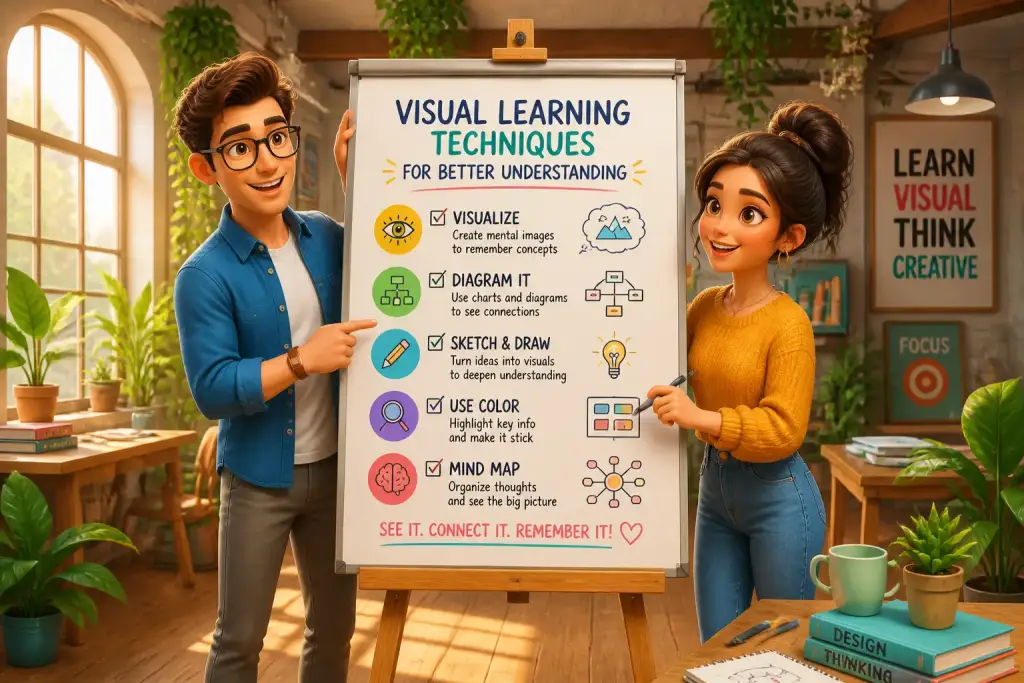
Pair the Feynman Technique with creative visualization to reinforce your understanding.
Reflect and Refine Your Understanding
The final step in applying the Feynman Technique involves reflection. Take time to think about what you have learned and how you can apply it. Reflecting on your study process helps identify what worked well and what could be improved. This step is crucial for continuous learning and growth.
Consider keeping a learning journal where you document your reflections after each study session. Write down insights, challenges, and strategies that worked for you. This journal not only serves as a record of your learning journey but also allows you to review your progress over time. Regular reflection helps you stay engaged and motivated, making learning a more enjoyable experience.
Think about how the concepts you have learned connect to real-world situations. For example, if you studied economic theories, reflect on how they apply to current market trends. Making these connections enhances your understanding and retention of information. It also prepares you to use your knowledge in practical situations.
Steps for Effective Reflection
- Keep a journal of learning experiences and insights.
- Regularly review your notes to reinforce understanding.
- Connect concepts to real-world applications.
- Set goals for future learning based on your reflections.
Overall, applying the Feynman Technique in your studies can transform your learning experience. By breaking down complex topics, teaching others, identifying knowledge gaps, testing yourself, and reflecting on your learning, you can significantly enhance your understanding and retention of information. This approach not only makes studying more effective but also more enjoyable. Whether you are preparing for exams, learning new skills, or pursuing personal interests, the Feynman Technique offers a straightforward path to deeper understanding and mastery of any subject.